Darioo Industrial / Line 05
Custom Jigs, Fixtures & Tooling Design & Manufacturing
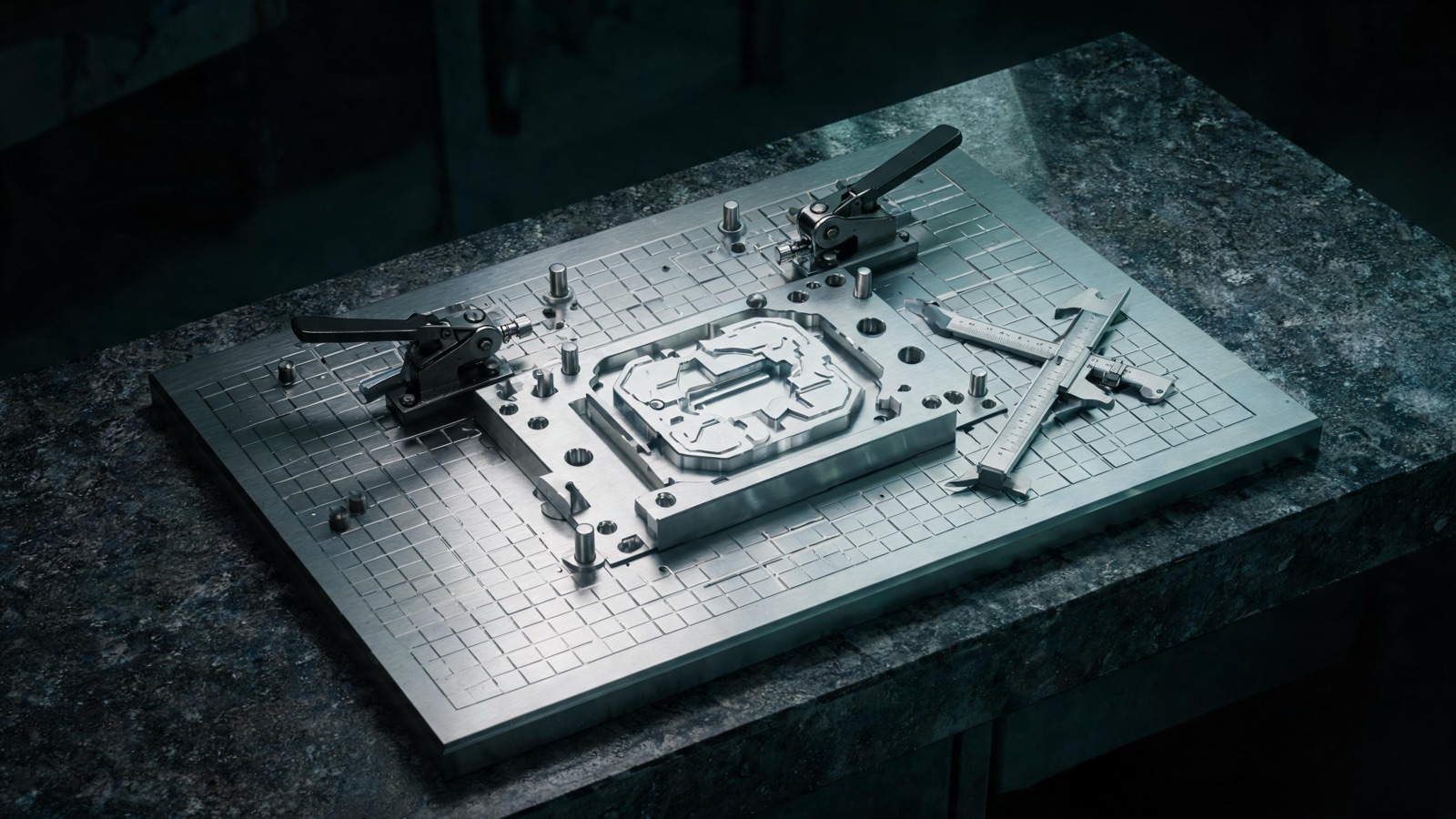
We design tooling against your part model and validate it before delivery, so every operator on every shift builds the same part the same way.
Overview
Repeatability you can bolt to the table.
Most scrap and rework does not start on the machine. It starts at the fixture, or at the lack of one, when a part gets clamped, welded, or measured a slightly different way depending on who is standing at the table that day. Darioo Industrial designs and builds the jigs, fixtures, and workholding that take that variation out of the process.
We work from your part model in SolidWorks, so the fixture is built to the geometry that actually exists, not a rough sketch of it. Locating points, clamping forces, and datum surfaces get worked out on screen before anything is machined, and we machine the tooling ourselves in Charlotte, so changes during design do not turn into a lost week waiting on an outside vendor.
Before a fixture leaves our shop, it gets checked against your part, not just against the drawing. That validation step is what lets you hand a new fixture to a new operator on day one and get a part that measures the same as the one your best operator built last week. It is also what keeps go/no-go gauges honest and poka-yoke tooling from ever letting the wrong part through.
- Weld and assembly fixtures
- CNC workholding
- Inspection and go/no-go gauges
- Poka-yoke error proofing
The problem
The variation that starts at the fixture, not the machine
First article looks right. That is the part everyone checks, the part that gets photographed for the customer file, and the part that proves the process works. What nobody checks is part two hundred, built by a different operator on a different shift, located against the same print but not the same fixture. When there is no fixture at all, and a part gets clamped by feel, that drift is not a possibility. It is a certainty.
Operator-to-operator variation shows up as scrap and rework, but it starts earlier than either word suggests. It starts with a locating scheme that lives in the hands of one operator instead of in tooling. Weld fixtures without a real clamping strategy let a part walk during tack and pull out of spec as it cools, and the distortion does not stay contained. It shows up two stations later, when an assembly jig fights a weldment that is close but not right, and someone on your line spends an hour making it fit.
Inspection is where the cost finally gets a name, and it usually arrives as an argument. Without a gauge, pass or fail comes down to whose measurement everyone trusts that day. A fixture ends that argument before it starts. It locates the part the same way every time, it holds through the process instead of fighting it, and it gives your inspection station a fast, repeatable answer instead of an opinion.
Read the signs
A fixture will pay for itself on your floor if
- Quality varies depending on which operator or which shift built the part
- Setup takes longer than the operation it is supporting
- The rework station is always busy, every week, without fail
- Welds pull parts out of spec during tacking or as they cool
- A new hire needs weeks of coaching before parts come out right
- Inspection comes down to someone eyeballing it and an argument about who is right
- The same part gets built two different ways in two different cells
What you get
Everything this line covers, delivered by one team.
Fixture design against your part model
Locating scheme, clamping layout, and datum strategy worked out in SolidWorks before any metal is cut.
Weld fixtures
Tooling that holds components in position through fit-up, tacking, and full weld without walking or distorting.
Assembly jigs
Fixtures that locate mating parts the same way every time, so torque, alignment, and fit stop depending on who is on the line.
CNC workholding
Vises, fixture plates, and modular workholding built for your part family and your machine, cutting setup time between runs.
Inspection and go/no-go gauges
Gauges that give operators a fast pass or fail read on a feature without a CMM trip for every part.
Poka-yoke error proofing
Tooling geometry that physically prevents the wrong part, wrong orientation, or missing component from moving forward.
In-house machining
Fixture bodies, plates, and hardware machined in our own shop, so tolerances hold and revisions do not wait on outside vendors.
Fixture validation
Tooling checked against your actual part before delivery, with any fit or clamping issue resolved before it reaches your floor.
Send a part model or a photo of the setup you have now
That is enough for an engineer to give you a real read on fixture concept and rough scope, before anything gets designed.
How this line runs
From first call to running on your floor.
Part model and process review
We start with your part model and how it moves through welding, assembly, machining, or inspection, so the fixture gets designed against the real process, not a guess at it.
Location strategy and fixture design
Locating points, clamping forces, and datum surfaces get worked out in SolidWorks before anything is machined, so the design gets tested on screen instead of on your floor.
Machine the fixture in-house
Fixture bodies, plates, and hardware are machined in our own Charlotte shop, so a design change during the build does not turn into a week lost waiting on an outside vendor.
Validate against the part model
Before anything ships, the fixture gets checked against your actual part, not just the drawing, so clamping, location, and clearance are confirmed while the fixture is still in our shop.
Prove on the floor with your operators
The fixture runs with your team on your equipment, so we catch anything the shop floor exposes that a design review cannot.
Document and support revisions
You get documentation on how the fixture locates and clamps the part, and when your part changes, we revise the tooling instead of starting from a blank sheet.
Where this fits
Applications and industries we build for.
- Weld cells and welding fixtures
- Manual and automated assembly stations
- CNC milling and turning workholding
- First article and in-process inspection
- Go/no-go dimensional gauging
- Poka-yoke and error-proofed assembly
- Automotive and mobility component manufacturing
- Metal fabrication and sheet metal shops
- Consumer products manufacturing
- Building products and textiles
- New product introduction and low-volume runs
- Fixture standardization across multiple shifts
What custom jigs and fixtures cover
Jig and fixture work covers more ground than most people expect. Weld fixtures hold components through fit-up, tacking, and full weld so nothing walks or distorts as heat goes in. Assembly jigs locate mating parts the same way every cycle, so alignment and fit stop depending on who is standing at the station. CNC workholding, from single vises to modular fixture plate systems, cuts setup time between runs and holds location consistently from the first part to the last.
Drill and rout jigs guide a tool to the same location on every part without laying out each one by hand, which matters as much for cycle time as it does for accuracy. Inspection and go/no-go gauges give an operator a fast pass or fail read on a critical feature without sending every part to a CMM. Most shops need some combination of these, not just one, and they get designed together so they agree with each other.
Fixture design and manufacturing in Charlotte, NC
Darioo Industrial designs and builds jigs, fixtures, and tooling in Charlotte, North Carolina, under one ISO 9001:2015 quality system. Design happens in SolidWorks against your actual part model, and the fixture bodies, plates, and hardware are machined in our own shop, not farmed out to a vendor we do not control. Manufacturers across the Carolinas and the Southeast use us for tooling the same way they use us for custom machines, and finished fixtures ship nationwide.
Keeping design and machining under one roof matters most when a fixture needs a change mid-build. A locating pin that needs to move half a millimeter, a clamp that needs more reach, a plate that needs a pocket added, all of that gets resolved on our floor in days, not routed through an outside shop queue.
- Design in SolidWorks against your part model
- Fixture bodies and hardware machined in-house
- One ISO 9001:2015 quality system start to finish
- Finished fixtures ship nationwide
Weld fixtures that control distortion
Weld distortion is a physics problem before it is a tooling problem, but the right fixture is how you manage it. Clamping strategy sets how much a part can move as it heats, and where. Locating points get placed off the datums that actually matter downstream, not just the ones that are easy to reach, so the weldment lines up with whatever assembly comes next instead of fighting it.
Sequence matters as much as clamping. A fixture that lets you tack in an order that balances heat across the part, instead of one that locks in stress on one side first, is what turns a weldment that is close every time into one that is right every time. We design the clamping and think through the sequence together, so the fixture and the weld plan are not fighting each other on your floor.
Poka-yoke and error-proof tooling
Some mistakes should not be possible to make, and poka-yoke tooling is how you build that guarantee into the fixture itself instead of relying on a checklist or a careful operator. A locating pin sized to only one orientation, a nest that will not close over the wrong part, a pilot that will not seat unless a feature is present. Each of these makes the wrong assembly physically impossible instead of just unlikely.
Go/no-go gauges do the same job for inspection. Instead of asking an operator to interpret a measurement, the gauge gives a binary answer, it fits or it does not. That takes judgment out of a step where judgment is exactly what causes disagreement between shifts, and it turns inspection into something a new hire can do correctly on day one.
Budget honesty
What actually drives jig and fixture cost
Fixture pricing depends on what the tooling has to do, not a flat rate per part. These are the factors that move the number, so you can see the trade-offs while the design is still on screen.
Part size and complexity
A small, simple bracket needs a fraction of the tooling that a large, multi-feature weldment needs. Geometry drives fixture size, and fixture size drives material and machining time.
Tolerance targets
Holding a loose tolerance is straightforward. Holding a tight one repeatably means more precise locating, tighter-toleranced fixture components, and typically more validation before the fixture ships.
Production volume and duty cycle
A fixture used a few times a week can be simpler than one that runs three shifts. Wear parts, hardened locators, and quick-clear features earn their cost on high-duty tooling.
Changeover and family tooling
A dedicated fixture for one part is the cheapest single unit. Modular tooling that handles a whole part family costs more up front and typically pays it back in changeover time saved.
Validation and gauge requirements
A fixture that only needs to hold a part is different from one that also has to prove a critical dimension. Building gauging into the tooling adds scope, and it is worth defining early.
Side by side
Locating by skill vs locating by fixture
Every shop runs on one of these two systems, whether anyone chose it on purpose or not. Here is what typically changes when a shop moves from one to the other.
| By operator skill | By fixture | |
|---|---|---|
| Part-to-part consistency | Varies with attention, fatigue, and who is at the station that day | Holds steady because the geometry, not the operator, sets the location |
| Training time for new operators | Weeks of coaching before parts come out consistently right | A new hire can typically build a good part on day one |
| Scrap and rework behavior | Drifts over a shift and differs from one shift to the next | Stays flat because the fixture repeats the same setup every cycle |
| Setup time | Depends on how carefully each operator lays the part out by hand | Set by the fixture, typically a fraction of a manual layout |
| Inspection disputes | Comes down to whose measurement gets trusted that day | A gauge gives a pass or fail answer nobody has to argue about |
| What happens when your best operator leaves | The knowledge walks out the door with them | The fixture stays on the table and the next operator uses it the same way |
Line 05 questions
Asked on almost every jigs & fixtures call.
What do you need from us to design a fixture?
A part model is the fastest path to an accurate design, whether that is a SolidWorks file, a STEP file, or another CAD format we can import. If you only have a physical sample or a print, that works too. We can scan or measure the part and build the model ourselves before design starts.
Can you build workholding for an existing CNC program?
Yes. We design fixtures and workholding around the machine, fixture, and program you already run, so the goal is faster setup and consistent location, not a rework of your process. If your current workholding is the reason changeovers take too long, that is a common starting point for this kind of project.
How do you make sure a fixture actually fits the part before it ships?
We validate every fixture against your actual part, or against a sample part you provide, before it leaves our shop. That means checking clamping, location, and clearance against the real geometry, not just against the drawing, so problems get caught here instead of on your floor during first article.
Do you handle fixtures for a whole part family, not just one part?
Yes. Modular fixture plates and interchangeable locating and clamping components let one base fixture handle several parts in a family, which cuts down on the number of dedicated fixtures your team has to store, track, and set up.
Can you design a fixture from a physical part if we do not have CAD?
Yes. If there is no model, we measure or scan the part and build the geometry ourselves before fixture design starts. It adds a step to the front of the project, but it does not slow down the design work once we have something accurate to design against.
How do you validate a fixture before it ships?
Every fixture gets checked against your actual part, or a sample part you send us, before it leaves our shop. That means confirming clamping, location, and clearance against real geometry, not just the drawing, and running the fixture through the motion it will see on your floor so problems get caught here instead of during your first production run.
Can a fixture be designed now for automated loading later?
Yes, and it is worth flagging at the start of the design, not after the fixture is built. We can design locating and clamping so a robot or a feeder can load the part later without a redesign, even if the station is fully manual on day one.
Do you revise a fixture when our part changes?
Yes. Parts change as products get updated, and a fixture built around an old revision stops being an asset the moment that happens. We keep the design on file and revise the tooling to match the new part, which is typically faster and cheaper than building a new fixture from nothing.
Related lines
Often scoped together with this work.
Start here
Talk to an engineer about line 05.
Send the part, the problem, or the machine that is fighting you. We will tell you straight whether this line is the right fix.