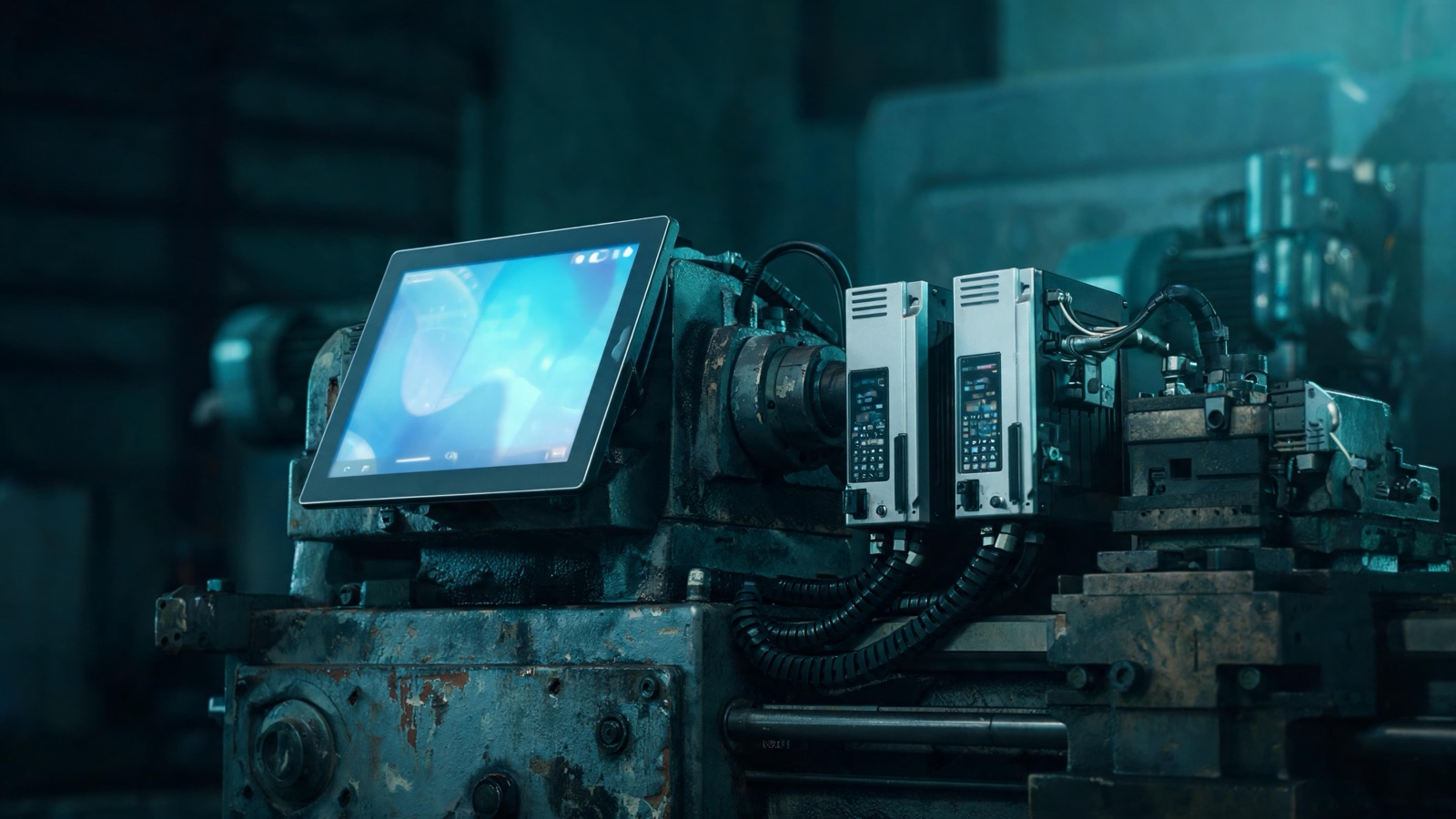
You’ve got a machine on the floor that still does the job, mostly. It runs, but the fault codes are getting stranger, and the guy who understood the controls retired two years ago. Every time something breaks, your maintenance team spends half a day hunting for a part that stopped shipping years back.
At some point every plant manager asks the same question: fix this thing again, or replace it? The honest answer depends on what’s actually wearing out. A machine’s mechanical structure and its control system age on different timelines, and mixing those two up is how plants end up scrapping a good frame or throwing new controls on a machine that’s mechanically done.
This guide walks through how to tell the difference, score what you’ve got, and make the call without guessing.
Separate the mechanics from the controls
Start by splitting the machine into two questions instead of one.
The mechanical question: is the frame, bed, spindle, bearings, and structure still sound? Mechanical wear shows up as loss of positioning accuracy, vibration that wasn’t there before, backlash in the drive train, or surface finish degrading no matter how you tune the process. It’s often expensive and slow to fix, but it’s predictable. A ballscrew can be replaced. Ways can be reground.
The controls question: is the PLC, HMI, drives, and wiring still supportable? Controls wear out differently. They don’t get looser, they get unsupported. The manufacturer stops making the processor. The programming software only runs on an operating system nobody uses anymore. This is obsolescence, not wear, and it has nothing to do with how well the machine still cuts, forms, or moves parts. If that’s your whole problem, our PLC migration guide walks through how to plan that project on its own.
Most retrofit decisions go wrong because someone treats these as one problem. A machine with a tired PLC but a rigid, accurate structure is a strong retrofit candidate. A machine with worn ways and a loose spindle isn’t fixed by a new control panel, no matter how good it is.
Score the machine in a walk-around audit
Before you can decide anything, you need an honest picture of where the machine stands today, not where it stood on paper when it was new. A walk-around audit gets you that picture fast, and it works best when you score the mechanical side and the controls side separately instead of forming one gut-feel impression of “this machine is old.”
Walk the machine with your best operator and maintenance lead together. On the mechanical side, look at:
- Positioning repeatability and backlash across a full cycle, not just at idle
- Vibration or noise under load that wasn’t there earlier in the machine’s life
- Surface finish or part quality drifting even after normal process tuning
- Structural rigidity, frame condition, and any visible cracking or fatigue
Rate what you see in plain terms: sound, wearing but serviceable, or failing. A frame that’s sound and holding tolerance scores well even if it looks rough cosmetically.
On the controls side, check whether the programming software still runs on a laptop your team owns, whether the manufacturer still sells replacement modules, and whether anyone besides the one person who’s been here twenty years can read the logic.
Once you have both scores side by side, the decision usually sorts itself. A machine that scores well mechanically but poorly on controls is a retrofit candidate; one that scores poorly on both is heading toward replacement. Keep the scores separate, because blending “the whole machine feels old” into one impression loses the distinction that makes this decision solvable.
Check spare parts availability before anything else
Before you decide anything, find out how exposed you actually are. Pull your maintenance records for the last two to three years and look at what broke and where the part came from.
- List every PLC, drive, HMI, and major component still under active production support from the manufacturer
- Note anything you’ve already had to source from a broker, an auction, or a used-parts reseller
- Ask your maintenance team how many hours they spent last year just locating parts, not fixing anything
- Identify single points of failure: one part that, if it dies, stops the whole machine with no fallback
If you’re already buying spares from resellers, you’re not maintaining the machine anymore. You’re managing a slow-motion outage, and that’s usually the clearest signal a retrofit needs to happen soon, before the decision gets made for you at 2am on a production night.
Put a number on downtime, not just repair cost
The mistake plants make most often is comparing the price of a retrofit or a new machine against the price of “just fixing it one more time.” That’s the wrong comparison. The real cost of staying on obsolete controls is the downtime risk you’re carrying, not the repair invoice.
Ask what happens if this machine goes down tomorrow and stays down for a week because the part isn’t available anywhere. In most plants, that risk is a lot bigger than the retrofit quote, and it just doesn’t show up on a purchase order. Modern controls also tend to pay for themselves in ways that are hard to see up front, mainly better diagnostics and remote troubleshooting access.
The hidden costs each side forgets
Every retrofit-versus-replace conversation eventually turns into a comparison of quotes. That comparison is almost always incomplete, because both sides carry costs that don’t show up on the number.
What replacement costs beyond the machine itself
A new machine’s purchase price is rarely the real number. Rigging alone can be significant: getting the old machine out, prepping the foundation or utilities, and getting the new one in and leveled. A different footprint turns that into construction work, not just installation.
Then there’s training, since a new machine usually means different controls and fixturing. Your operators know the old machine’s quirks, not the new one’s, and that learning curve costs production time even after the machine is running.
The cost people forget most is process re-validation. If your parts are qualified to a customer spec, a new machine often means requalifying from scratch, even if it’s objectively better, with new first-article inspections and sign-off from a customer who wasn’t expecting to hear from you. None of it is optional or quick.
What retrofit costs beyond the quote
Retrofits have their own blind spot: what you find once the panel is open and the machine is apart. A quote is built on what’s visible and assumed from the machine’s age and model. Once inside, it’s common to find wiring that doesn’t match the drawings, sensors added informally and never documented, or components that need attention nobody planned for.
This isn’t a sign the retrofit was scoped badly, it’s normal for a machine patched for years. Manage it by building a documentation and discovery phase into the scope before final pricing locks, with contingency for what gets found once the machine is open. Darioo Industrial builds that discovery phase into every control panel and PLC retrofit scope, so contingency is planned for, not a surprise change order.
A worked decision walkthrough
Here’s how this plays out in a typical plant, without attaching dollar figures to it, because the numbers differ in every shop and the reasoning is what transfers.
Say you’ve got a machine that’s fifteen years old. The walk-around audit shows the mechanical structure sound and holding tolerance, with ways and bearings reconditioned a few years back. The controls audit shows a PLC two support stages past end of life and a programming file nobody can open. The spare parts check backs that up: your team has bought three modules from a broker in eighteen months, and the last one took six weeks to arrive.
The reasoning here is straightforward. The mechanical platform is worth keeping, and the controls are the actual risk in the building. A retrofit lets you keep a structure you already trust while removing the failure point threatening your schedule, without gambling on a new machine’s teething problems or requalifying a process that already works.
Now flip one variable. Same machine, same age, but repeatability has drifted, and your process engineer says the tolerances you need today are tighter than what this machine was built to hold. In that version, modern controls wouldn’t matter, you’d be putting a new brain on a body that can’t do the job anymore. The variable that actually decides the outcome is almost never the age of the machine. It’s whether the mechanical structure can still do the job.
When retrofit is the right call
Retrofit tends to make sense when the mechanical structure is sound, the frame is rigid, and the wear items can be replaced or reconditioned without touching the core structure. If geometry and repeatability are still good, and the main problem is that the controls are old, unsupported, or hard to program, a machine retrofit and modernization lets you keep a proven mechanical platform and pair it with modern controls, drives, and an HMI your team can actually use.
Retrofits also make sense when the machine is a known quantity in your process. If your operators, tooling, and fixtures are built around it, modernizing the controls avoids a much bigger disruption than the retrofit itself.
When replacement actually wins
Replacement wins when the mechanical condition is the problem, not just the controls. If the structure has lost rigidity, repeated repairs aren’t holding, or the accuracy you need is no longer achievable no matter what you do to the drive train, a retrofit just delays a bigger expense. You’d be putting new controls on a machine that can’t hold the tolerance you need.
Replacement also wins when the machine is undersized for where your production is headed. A retrofit modernizes what you already have, it doesn’t add capacity or capability the original design never had. If your volumes have grown past what this machine was built for, that’s a different conversation than obsolete controls. And sometimes the math is simpler than expected: if the retrofit scope, once you include downtime and requalification, starts approaching what a new machine costs, replacement usually wins on total cost before you even factor in the extra capability.
Planning a retrofit cutover around production
Once you’ve decided a retrofit is right, the next question is how to do it without stopping the plant for longer than you can afford. Front-load the work that doesn’t require the machine to be down, and compress the work that does.
Everything that can happen before the cutover window should happen before it: building and testing the new panel on a bench, simulating the new PLC program against documented I/O, staging components, and training operators on the new HMI before they touch the real machine. None of that requires the machine to be offline.
What actually requires downtime is disconnecting the old system, wiring in the new one, and running the machine through a full validation cycle. If your prep work was thorough, that window can be genuinely short. If it wasn’t, you’re doing discovery and troubleshooting live, on a schedule you don’t control.
Schedule the cutover around a planned shutdown or slow production period rather than a normal week. Build in time after power-up for a real validation run, not just a check that the machine moves. Run parts through the full cycle and walk operators through the new HMI while someone who understands the system is still there. A field engineering and maintenance team that stays through the first production runs catches small issues before they become a Monday morning problem.
The plants that get short cutovers treated the window as the last step of a long preparation process, not the whole project.
Common questions
How long does a retrofit typically take compared to buying new equipment? Timelines vary with scope, but the cutover is often shorter than the lead time on a new machine, which can mean months before it arrives. A retrofit’s biggest time cost is usually the planning phase, not the changeover.
Can you retrofit a machine more than once over its life? Yes, and many plants do. If the mechanical structure keeps holding tolerance, there’s no rule you only get one modernization. What matters each time is running the same mechanical-versus-controls audit again.
What if only some of the controls are obsolete, not all of them? Partial obsolescence is common and usually still supports a retrofit. You don’t have to replace every drive and sensor if they’re still supported. The goal is removing the specific unsupported component, usually the PLC or HMI, without tearing out parts that work fine.
Who should do the mechanical and controls audit, our team or an outside integrator? Your maintenance team knows the machine’s history and should be part of it either way. An outside integrator adds an unbiased read on mechanical condition and what’s achievable with modern controls, useful since it’s easy to be too attached to a machine you work on every day.
The takeaway
Retrofit and replace aren’t opposite ends of one decision, they’re answers to two different questions: is the mechanical structure sound, and can the controls be supported. Score both separately, get spare parts data and a real downtime picture, and price in the hidden costs on both sides, because those factors usually make the decision obvious on their own. If the frame is solid, retrofit protects your investment. If the mechanics are the problem, replacement is the honest answer, even if it costs more up front. Darioo Industrial runs this evaluation the same way every time, mechanical first, controls second, so the recommendation is based on what your machine actually needs.